


Federal Government creates stable demand for high-quality RFNBO hydrogen by 2040

The GHG reduction target and the tradability of guarantees of origin for meeting this target have created a competitive market for renewable energy sources in the transport sector. The current legal framework sets out the progression of the GHG reduction target up to 2030. The price of the certificates fluctuates in line with supply and demand. The GHG reduction quota and its annual increase ensure stable or rising demand. Furthermore, the Act contains further provisions designed to ensure fair competition between different renewable energy sources, e.g. multiple counting of the use of certain energy sources towards quota fulfilment. In recent years, the price of guarantees of origin has plummeted to around €100 per tonne of GHG savings. A key reason for this lies, among other things, in the sudden supply of enormous quantities of certificates from biofuels with dubious certification originating from Asia.
The Act on the further development of the GHG reduction target, finally adopted by the Bundestag on April 22nd and by the Bundesrat on May 8th, addresses this challenge by the GHG reduction target which will be maintained until 2040 with further annual increases, by implementing EU requirements under the Renewable Energy Directive III, and by adjusting the details of the eligibility of different energy sources in line with their maturity and current developments.
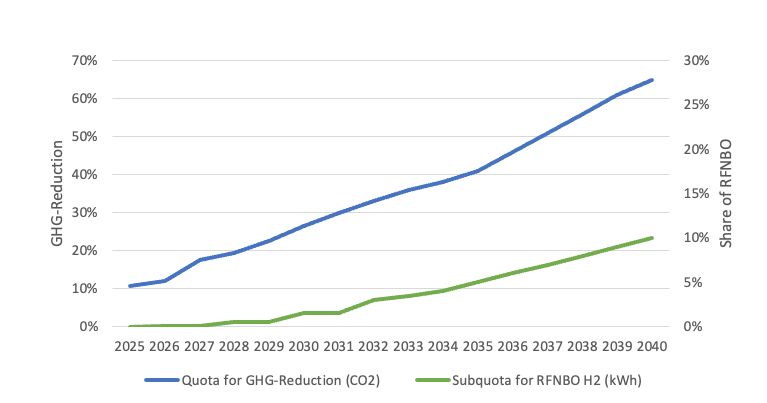
The Act provides for a further increase in the GHG reduction target (left axis) as well as the introduction and annual increase of a minimum RFNBO sub-target, which is intended to incentivise and safeguard the roll-out of H2 in transport. This will create a stable and steadily rising demand for high-quality RFNBO hydrogen at H2 filling stations and refineries.
In addition, the legislator has introduced further measures to stabilise the prices of guarantees of origin and to improve the steering effect.
- Biofuels derived from palm oil, soya oil, residues from oil palm cultivation, biofuels with a high risk of indirect land-use change, and biofuels derived from animal oils and fats will no longer be recognised.
- Furthermore, a prerequisite for the recognition of an energy source – particularly biofuels – within the framework of the GHG reduction quota is the possibility of an on-site inspection in the country where the biofuel is produced, carried out by the competent authority of an EU Member State.
- As soon as it is identified that the GHG reduction target has been exceeded by a significant margin, the GHG reduction target for all subsequent years will be raised further.
With these measures, the legislator aims to effectively and efficiently prevent projects of dubious origin from driving down the market price for all stakeholders and thereby penalising reputable market participants.
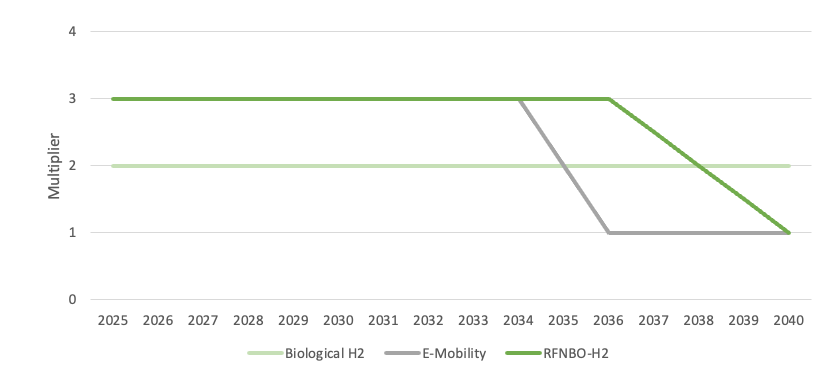
The existing multiple counting of certain energy sources enables policymakers to provide special support for individual energy sources. In this way, policymakers steer competition between energy sources to a certain extent and make it easier for the industry to meet its quotas. If multiple counting decreases, this has the effect on the market of tightening the GHG reduction quota for all energy sources.
The multiple counting for e-mobility will decrease linearly from 2034. As a result, the e-mobility fleet existing in Germany in 2034 will generate only a third of the GHG certificates in 2036. Policymakers therefore anticipate a sharp rise in e-mobility during this period. The multiple counting for H2 and RFNBO will decrease later, i.e. from 2036 onwards. The later reduction in multiple counting for RFNBO, together with the mandatory minimum RFNBO sub-quota, will result in a stable competitive advantage for H2 in the mobility sector.
For aviation, the draft bill also sets out additional guidelines. This is intended to transpose the relevant EU legislation, ‘ReFuelEU Aviation’, into national law. The EU stipulates that synthetic aviation fuels must account for at least 2% of the total in Europe by 2025, at least 6% by 2030, at least 20% by 2035 and at least 34% by 2040. The draft bill stipulates a levy or penalty payment of €4,700 per tonne in the event of non-compliance. For synthetic aviation fuels based on RFNBO, a minimum sub-quota of 1.2% is set for 2030, 5% for 2035 and 10% for 2040. In the event of non-compliance, German distributors face a compensation payment of €17,000 per tonne. With these concrete measures, policymakers aim to ensure compliance with ReFuelEU Aviation.
The law now passed clearly demonstrates the current government’s commitment to sensibly developing the GHG quota system as a key instrument for the transformation of the transport sector. A wide range of measures will help ensure that the instrument effectively steers the market and triggers investment. We expect the price of GHG allowances or certificates to recover gradually between now and 2030 and stabilise at a significantly higher level than today.